After lunch we moved on to the vicinity of the Berber outdoor market en route to the medina (the old city), the souk and the bazaar, passing a small Mosque on the way. As mentioned in the earlier Tangier post religious freedom is enshrined in the constitution so, while it is predominantly a Muslim city with many Mosques, there are at least nine Synagogues and several Christian churches. We passed one large Mosque on the bus trip but, unfortunately, it was not otherwise part of the tour.
As mentioned, in centuries past Tangier was a Berber community and even today its population, we were told, is about 60% Berber. The Berbers are an agrarian and craft culture and their market is filled with produce and handicrafts of all kinds. Unfortunately I don't know exactly what, except what we can see in the photos, because we had to walk very quickly past their outdoor market area en route to the souk. In stopping to take these and a few other photos I was almost left behind. These photos were composed very quickly and most were made with a telephoto lens because it would not have been possible otherwise.
A few more photos made on our quick trip past the Berber market.
This table of bread is the first stall we saw when entering the souk. Once again, the passage through this amazing gathering of food was extremely fast so I was lucky to get these few photos. Beyond the bread stall is one displaying several kinds of olives (we were told that there are at least 20 different kinds of olives) and a range of other fruits and vegetables, similar to the stall in the photo below.
We were quickly led out of the souk past all manner of other interesting booths of food but with no time to find out what they were. The young man in this photo was the guide's colleague and the one responsible for keeping us from straying and getting lost, which he did effectively and gently but firmly.
It turned out that we were now on our way to the bazaar and to get there we had to pass through very narrow "streets" and keep saying "no" to no end of street vendors who were very much "in your face" persistently trying to sell you their particular items - jewellery, plates, leather purses, rugs, etc. Follow the Tilley hats, was one of the guide's suggestions.
All of this rush, it seems, was to get to the bazaar in time for an educational and sales presentation about carpets. The presentation was very informative, interesting and extremely well done, and clearly designed to encourage the purchase of a carpet or two.
And as you can see, the place was filled with a wide range of very tempting,very beautiful hand produced carpets, among other things which, unfortunately, you can't see. In the photo above the young man was attempting to demonstrate that the carpets are "fire proof".
This is a stack of some of these beautiful carpets.
And these are equally beautiful leather "poofs" or hollow leather balls that one fills with paper or styrofoam pellets to make a foot stool. We bought two, one medium size and one small.
Then we were off again through another set of narrow streets and the same group of street vendors to reach the spices and oils, etc. purported to make you look 5 years younger or provide that much sought after aphrodisiac. In this photo I am being scolded for taking it.
Here is the group once again listening to an interesting and very engaging presentation/sales pitch for the spices, powders and oils all credited with a range of attributes and powers. It was surprising to me how many sales were made.
Then we slipped out a side door in an effort to avoid the street vendors but without success. More narrow streets and the need to continue to say no.
We were folllowed all the way to the port where we finally did leave the salesmen behind. All of this was a lot of fun as long as you realize that this is their living. They were very persistent but in no way unpleasant or abusive.
From here it was onto the ferry/hydroplane and off on our 40 minute ride back to Algeciras.
Gibraltar next.
Monday, March 12, 2012
Sunday, March 11, 2012
Tangier (Tangiers in Berber and Arabic, Tánger in Spanish, Tânger in Portuguese and Tanger in French)
With apologies for the length of this post, here we go - and remember for a larger image..well you know.
The image below is a view of Tangiers on arrival at the ferry port.
This was fascinating visit but for a couple of reasons, not ideal for the kind of photography that I would have preferred. First, it is tightly scheduled so, while the guides allow some time for photos at specific stops, it is necessarily short in order to stay on schedule so many photos in the next Tangiers post were made "on the run". Secondly, many people in this part of the world for personal and cultural reasons, do not want to be photographed either specifically or as part of a group or crowd. In some instances I did a bit of an "end run" taking a photograph of an individual who did not know s/he was being photographed by either using a zoom lens or by being sufficiently surreptitious. On a couple of occasions my technique was not successful. I'm sorry if I offended anyone.
Tangiers is a city of over 700,000 people on the North African coast at the western entrance to the Strait of Gibraltar, where the Atlantic Ocean meets the Mediterranean Sea. (The adjacent photo was taken at that spot - Atlantic to the left, Mediterranean to the right.)
The city has a complex history, apparently originally founded by the Carthaginians around the 5th century BC. It was a Berber and Phoenician town that, over the centuries, was under the control or influence by the Romans, then a series of Arab rulers and others before the Portuguese conquest in 1471. The Portuguese rule lasted, except for a 60 year period of Spanish rule, until 1661; just under 200 years. (The photo below taken from the moving bus shows a bit of the country side we saw on our driving tour, mentioned below.)
The Portuguese gave it to the British as part of a dowry, the British were forced to leave by a Moroccan Sultan and in the late 19th and early 20th centuries the French and Spanish became involved in the area leading to the partition of Morocco into French and Spanish Morocco. In 1923 Tangiers was made an international zone under the administration of France, Spain and Britain, joined in 1928 by Portugal, Belgium and Italy. For a brief period between 1940 and 1945 it was under Spanish control until the International Zone was reesetablished in 1923. The period from 1923 to 1956, when Tangier joined Morocco following the full restoration of Moroccan sovereignty, is considered by some to be the golden period in the history of Tangiers. I know, more than you wanted to know.
On arrival we were taken by a local guide on a driving tour of this modern and growing city as well as to some "outlying" areas. While on this tour we learned that Morocco has some very progressive policies including "free" tax supported education and health care as well as an investment in low income housing. In addition, although there are some residual traditional limitations for women, for the most part women have similar rights to education and participation in public life and employment as men - for example 30% of the members of parliament are women, a number which may well exceed the percentage in Canada. Also, religious rights for all religions are ensured by the constitution.
First stop on the driving tour was for photos at the junction of the Atlantic Ocean and the Mediterranean Sea (see photo of the rocks above) and then on to the camel rides. Ruth was keen to ride a camel and she appears to be enjoying it.
But the camel was not pleased and raised a fuss which required a bit of restraining by her handler.
Below is quite a nice view from the camel riding site. Sorry, I don't recall what the buildings on the left are.
After the camel rides we were driven back into Tangiers for a very interesting and entertaining lunch, in a large and colourful tent. As you can see we had a welcoming committee (one of these mounted guards on each side of the entrance) - this fellow may not look it, but he was very friendly.
This main course consisted of, on the left, couscous, apparently originally north African which I did not know, with chick peas and vegetables - and on the right lamb meatballs in tomato sauce garnished with poached eggs. Extremely tasty and colourful enough to merit a photo, I thought.
And while eating we were entertained by these three musicians, a couple of male dancers and a belly dancer. The photos of these entertainers are quite blurred because there was too much movement for the amount of available light and I don't like using a flash.
After lunch, we were on our way to the old city (the medina), the Berber outdoor market (which we passed by much too quickly for my taste), the souk (the indoor market) then on to the Bazaar.
This is already far too long, so more about these in the next post.
The image below is a view of Tangiers on arrival at the ferry port.
This was fascinating visit but for a couple of reasons, not ideal for the kind of photography that I would have preferred. First, it is tightly scheduled so, while the guides allow some time for photos at specific stops, it is necessarily short in order to stay on schedule so many photos in the next Tangiers post were made "on the run". Secondly, many people in this part of the world for personal and cultural reasons, do not want to be photographed either specifically or as part of a group or crowd. In some instances I did a bit of an "end run" taking a photograph of an individual who did not know s/he was being photographed by either using a zoom lens or by being sufficiently surreptitious. On a couple of occasions my technique was not successful. I'm sorry if I offended anyone.
Tangiers is a city of over 700,000 people on the North African coast at the western entrance to the Strait of Gibraltar, where the Atlantic Ocean meets the Mediterranean Sea. (The adjacent photo was taken at that spot - Atlantic to the left, Mediterranean to the right.)
The city has a complex history, apparently originally founded by the Carthaginians around the 5th century BC. It was a Berber and Phoenician town that, over the centuries, was under the control or influence by the Romans, then a series of Arab rulers and others before the Portuguese conquest in 1471. The Portuguese rule lasted, except for a 60 year period of Spanish rule, until 1661; just under 200 years. (The photo below taken from the moving bus shows a bit of the country side we saw on our driving tour, mentioned below.)
The Portuguese gave it to the British as part of a dowry, the British were forced to leave by a Moroccan Sultan and in the late 19th and early 20th centuries the French and Spanish became involved in the area leading to the partition of Morocco into French and Spanish Morocco. In 1923 Tangiers was made an international zone under the administration of France, Spain and Britain, joined in 1928 by Portugal, Belgium and Italy. For a brief period between 1940 and 1945 it was under Spanish control until the International Zone was reesetablished in 1923. The period from 1923 to 1956, when Tangier joined Morocco following the full restoration of Moroccan sovereignty, is considered by some to be the golden period in the history of Tangiers. I know, more than you wanted to know.
On arrival we were taken by a local guide on a driving tour of this modern and growing city as well as to some "outlying" areas. While on this tour we learned that Morocco has some very progressive policies including "free" tax supported education and health care as well as an investment in low income housing. In addition, although there are some residual traditional limitations for women, for the most part women have similar rights to education and participation in public life and employment as men - for example 30% of the members of parliament are women, a number which may well exceed the percentage in Canada. Also, religious rights for all religions are ensured by the constitution.
First stop on the driving tour was for photos at the junction of the Atlantic Ocean and the Mediterranean Sea (see photo of the rocks above) and then on to the camel rides. Ruth was keen to ride a camel and she appears to be enjoying it.
But the camel was not pleased and raised a fuss which required a bit of restraining by her handler.
Below is quite a nice view from the camel riding site. Sorry, I don't recall what the buildings on the left are.
After the camel rides we were driven back into Tangiers for a very interesting and entertaining lunch, in a large and colourful tent. As you can see we had a welcoming committee (one of these mounted guards on each side of the entrance) - this fellow may not look it, but he was very friendly.
This main course consisted of, on the left, couscous, apparently originally north African which I did not know, with chick peas and vegetables - and on the right lamb meatballs in tomato sauce garnished with poached eggs. Extremely tasty and colourful enough to merit a photo, I thought.
And while eating we were entertained by these three musicians, a couple of male dancers and a belly dancer. The photos of these entertainers are quite blurred because there was too much movement for the amount of available light and I don't like using a flash.
After lunch, we were on our way to the old city (the medina), the Berber outdoor market (which we passed by much too quickly for my taste), the souk (the indoor market) then on to the Bazaar.
This is already far too long, so more about these in the next post.
Saturday, March 10, 2012
Sevilla
Our three day trip from March 7 - 9th saw us in 4 countries (Portugal, Spain, Morocco and Great Britain), 3 kingdoms (Spain, Morocco and the United Kingdom) and 2 continents (Europe and Africa).
Remember to click on any photo to see a larger version.
The first stop of the tour was in Sevilla in Spain where we spent about 6 hours. Ruth and I had been in Sevilla in 2008 so, while we had a relaxing break from the bus ride, there was not a whole lot that was new during this tour.
And the first stop in Sevilla is to visit the beautiful Plaza d'España, which we had visited the last time in Sevilla (see my blog at
March 2008 for more information about the Plaza).
Use your browser back arrow to return to the blog.
As you can no doubt appreciate, the first several photos are images from around the Plaza d'España.
This photo was taken from the upper floor area of the Plaza buildings - the attraction was a woman here selling colourful folding fans.
After the visit to the Plaza d'España there was a local tour guide walk around the central area of Sevilla, including a tour of the Roman Catholic Catedral de Santa María de la Sede, said to be the largest Gothic cathedral and one of the 3 largest churches in the world. We did not do the cathedral tour.
This photo was taken inside the Alcazar exit area and shows the cathedral tower and the top of the Alcazar wall which is identifiable by the small turret like structures. It appears that the cathedral tower is growing out of the Alcazar wall but the cathedral is actually a short distance away.
Regrettably, we did not take the time to visit the Moors' castle, the Real Alcazar. A few photos of the Alcazar from our last visit to Sevilla are at Alcazar
After leaving the tour we strolled around, had lunch then a glelato at this small square with the orange tree.
Found an interesting ceramics place with lots of brightly coloured things where we parted with a few Euros.
As I mentioned in my 2008 blog, orange trees abound in Sevilla. These produce quite sour oranges which are converted in Scotland or England into Seville Orange Marmalade. The oranges are so bitter that people rarely eat them, no matter how available they are - witness them lying all over the ground in this public park in central Sevilla.
We left Sevilla around 4:15 pm on our way to the town of Algeciras, where we stayed for two nights. Algeciras was our base for the trips to Tangier on Thursday and Gibraltar on Friday. More about each of those adventures later.
Remember to click on any photo to see a larger version.
The first stop of the tour was in Sevilla in Spain where we spent about 6 hours. Ruth and I had been in Sevilla in 2008 so, while we had a relaxing break from the bus ride, there was not a whole lot that was new during this tour.
And the first stop in Sevilla is to visit the beautiful Plaza d'España, which we had visited the last time in Sevilla (see my blog at
March 2008 for more information about the Plaza).
Use your browser back arrow to return to the blog.
As you can no doubt appreciate, the first several photos are images from around the Plaza d'España.
This photo was taken from the upper floor area of the Plaza buildings - the attraction was a woman here selling colourful folding fans.
After the visit to the Plaza d'España there was a local tour guide walk around the central area of Sevilla, including a tour of the Roman Catholic Catedral de Santa María de la Sede, said to be the largest Gothic cathedral and one of the 3 largest churches in the world. We did not do the cathedral tour.
This photo was taken inside the Alcazar exit area and shows the cathedral tower and the top of the Alcazar wall which is identifiable by the small turret like structures. It appears that the cathedral tower is growing out of the Alcazar wall but the cathedral is actually a short distance away.
Regrettably, we did not take the time to visit the Moors' castle, the Real Alcazar. A few photos of the Alcazar from our last visit to Sevilla are at Alcazar
After leaving the tour we strolled around, had lunch then a glelato at this small square with the orange tree.
Found an interesting ceramics place with lots of brightly coloured things where we parted with a few Euros.
As I mentioned in my 2008 blog, orange trees abound in Sevilla. These produce quite sour oranges which are converted in Scotland or England into Seville Orange Marmalade. The oranges are so bitter that people rarely eat them, no matter how available they are - witness them lying all over the ground in this public park in central Sevilla.
We left Sevilla around 4:15 pm on our way to the town of Algeciras, where we stayed for two nights. Algeciras was our base for the trips to Tangier on Thursday and Gibraltar on Friday. More about each of those adventures later.
Monday, March 5, 2012
Last post before trip to Seville, Gibraltar and Tangier
It seems I lied about no more posts until we return from our upcoming trip to Seville, Tangier and Gibraltar. I have a few more photos I wanted to show. This post will have a higher photo to text ratio, and it WILL be the last before we leave on Wednesday. Tomorrow I will be packing my bag.
This is another photo from our trip to Salir which I like a lot - hope you do as well.
Have I mentioned that you can click on any photo to see a larger version? :-)
Oops, another beach sunset. I like this one a lot as well.
Another fisherman on the breakwater. This fellow appears to be sitting resting waiting for something to happen. His fishing pole is hard to see but if you click on the photo to enlarge it, you can make out the pole several meters from him. I have seen a lot of these fishermen but have never seen one with a catch.
On my way to the beach this morning around 7 am, the sky was totally clear and the sun was already above the horizon providing a beautiful glow on some buildings. What looks yellow-orange here is actually pink.
And on my way back from the beach the sun was quite a bit higher and producing interesting light and shadows like this. I also like this one a lot.
Once again a beautiful evening at the beach after a sunny warm day. The moon is not quite full and shows pretty well considering this is a hand held photo.
This will definitely be the last post until after we return from our trip on Friday. Hopefully, after the trip there will be more to show and tell.
This is another photo from our trip to Salir which I like a lot - hope you do as well.
Have I mentioned that you can click on any photo to see a larger version? :-)
Oops, another beach sunset. I like this one a lot as well.
Another fisherman on the breakwater. This fellow appears to be sitting resting waiting for something to happen. His fishing pole is hard to see but if you click on the photo to enlarge it, you can make out the pole several meters from him. I have seen a lot of these fishermen but have never seen one with a catch.
On my way to the beach this morning around 7 am, the sky was totally clear and the sun was already above the horizon providing a beautiful glow on some buildings. What looks yellow-orange here is actually pink.
And on my way back from the beach the sun was quite a bit higher and producing interesting light and shadows like this. I also like this one a lot.
Once again a beautiful evening at the beach after a sunny warm day. The moon is not quite full and shows pretty well considering this is a hand held photo.
This will definitely be the last post until after we return from our trip on Friday. Hopefully, after the trip there will be more to show and tell.
Sunday, March 4, 2012
Sunday - again!
The last blog post was longer than usual - this one may turn out to be more than you would like with too much text. Remember to click on any photo to enlarge it.
In the last post about our trip to 3 villages, I mentioned passing through an area of cork trees. Unfortunately we didn't stop to get photos of these unique trees, but they did stop the bus briefly to let us see a large storage stack (more than 50 meters long) of cork tree bark, the stuff of cork.
Adjacent is a photo of part of the stack taken through the bus window. We learned that a tree must be about 25 years old before the "virgin" harvest of the bark. This virgin bark as well as the next harvest, 9 years later in Portugal, is generally of poor quality. Apparently in later harvests, again at 9 year intervals, the quality continues to improve. With a requirement of a 9 year wait between harvests one needs to have a lot of trees and be patient and organized in the harvest process in order to make it pay. We also learned that, while several countries produce cork, Portugal produces 50% of the world's cork and about 50% of it is used for bottle stoppers. There are, of course, lots of other uses and for more on cork you can visit http://en.wikipedia.org/wiki/Cork_(material)
An unexpected stop was at the place of the firewater lady in a very small hamlet. Firewater is a high alcohol drink (48% in this place) known as medronho, brewed in rural "mountainous" areas in the northern part of the Algarve. It is usually made by fermenting wild strawberries and in this location under, to me, somewhat surprising conditions. The primary fermentation takes place in open oak buckets and later the distilling process apparently moves to rather ancient looking copper "canisters", for want of a better term, which are connected to other containers by copper tubing. All takes place in a rather dark (no photo) extension of the sales area. A very poor photo of the almost as dark sales area where we were invited to sample the product, is above. There is little light in this room - though there were lights they were not on. You can see the there is much paraphernalia on the walls and hanging from the ceiling including animal traps, an old guitar and some horse harness equipment. Also, to the left is a pile of cork tree bark and in the centre of the photo there is a glimpse of the bottles of "firewater", all looking quite pristine. The tradition is to drink an ounce or so in one swallow. We didn't sample it.
I realize that I have shown a lot of photos of sunsets and sunrises made from the beach, but at the risk of continuing to overdo it, I thought this one from yesterday worth showing.
In my blog on the second full day in Albufeira I mentioned a newly constructed breakwater on the beach and showed a couple photos of same which you can see by clicking here. I have been tempted to climb onto it to see what it looks like on top and what I might see on the other side. Yesterday I did climb it. Above is a photo looking down its length.
Adjacent and below two views of the ocean and shore on the east side of the breakwater. In adjacent photo in the distance, I believe, is the city of Faro, the capital of the Algarve.
Likely no blog posts for a bit. On Wednesday we leave at 6:30am for our 3 day trip to Seville, Gibraltar and Tangier. Hopefully something interesting from there for the next blog post.
In the last post about our trip to 3 villages, I mentioned passing through an area of cork trees. Unfortunately we didn't stop to get photos of these unique trees, but they did stop the bus briefly to let us see a large storage stack (more than 50 meters long) of cork tree bark, the stuff of cork.
Adjacent is a photo of part of the stack taken through the bus window. We learned that a tree must be about 25 years old before the "virgin" harvest of the bark. This virgin bark as well as the next harvest, 9 years later in Portugal, is generally of poor quality. Apparently in later harvests, again at 9 year intervals, the quality continues to improve. With a requirement of a 9 year wait between harvests one needs to have a lot of trees and be patient and organized in the harvest process in order to make it pay. We also learned that, while several countries produce cork, Portugal produces 50% of the world's cork and about 50% of it is used for bottle stoppers. There are, of course, lots of other uses and for more on cork you can visit http://en.wikipedia.org/wiki/Cork_(material)
An unexpected stop was at the place of the firewater lady in a very small hamlet. Firewater is a high alcohol drink (48% in this place) known as medronho, brewed in rural "mountainous" areas in the northern part of the Algarve. It is usually made by fermenting wild strawberries and in this location under, to me, somewhat surprising conditions. The primary fermentation takes place in open oak buckets and later the distilling process apparently moves to rather ancient looking copper "canisters", for want of a better term, which are connected to other containers by copper tubing. All takes place in a rather dark (no photo) extension of the sales area. A very poor photo of the almost as dark sales area where we were invited to sample the product, is above. There is little light in this room - though there were lights they were not on. You can see the there is much paraphernalia on the walls and hanging from the ceiling including animal traps, an old guitar and some horse harness equipment. Also, to the left is a pile of cork tree bark and in the centre of the photo there is a glimpse of the bottles of "firewater", all looking quite pristine. The tradition is to drink an ounce or so in one swallow. We didn't sample it.
I realize that I have shown a lot of photos of sunsets and sunrises made from the beach, but at the risk of continuing to overdo it, I thought this one from yesterday worth showing.
In my blog on the second full day in Albufeira I mentioned a newly constructed breakwater on the beach and showed a couple photos of same which you can see by clicking here. I have been tempted to climb onto it to see what it looks like on top and what I might see on the other side. Yesterday I did climb it. Above is a photo looking down its length.
Adjacent and below two views of the ocean and shore on the east side of the breakwater. In adjacent photo in the distance, I believe, is the city of Faro, the capital of the Algarve.
Likely no blog posts for a bit. On Wednesday we leave at 6:30am for our 3 day trip to Seville, Gibraltar and Tangier. Hopefully something interesting from there for the next blog post.
Friday, March 2, 2012
Trip to Querença, Salir and Alte
Yesterday we left at 8:30 am for our one day trip to 3 tiny villages (Querença, Salir and Alte) in the hills just north of Albufeira. They are described as typical older and "traditional" Algarve communities, unspoiled by the tourism industry with its influx of people like us (they don't actually identify the "spoiler" - instead they refer to "modern life"). It was a pleasant but unexciting trip marred by a cool day with intermittent rain. Visiting churches, which seems to be essential, is of little interest to me (saw my fill in Italy) but while others were checking out the local church I had time to roam about in search of something interesting. The villages are quite attractive as well as charming and appear to be cleaned and "polished" for the visitors. In order to get to the villages we passed through some rather hilly country (including cork tree country) with some potentially attractive views but, except for two unscheduled places, we stopped only in the mentioned villages. By necessity the stops are generaly quite brief and structured and while it is very nice to visit and see these old style Portuguese villages, it is only a tiny taste and provides little time and place flexibility to try to capture the flavour of the region in photographs. In Salir we had 20 minutes or so to wander and in Alte, after an interesting lunch, we had about 45 minutes of "free time" - so time for a few photos. We were home by 4:30 pm.
After an unexpected hour or so in Loulé, we moved on to Querença. Pretty much the first thing you see in the plaza in front of the church in Querença is a collection of brightly painted cows - examples of same in these photos which Ruth took.
Not sure why they are there and our guide did not enlighten us. These reminded me of the Mel Lastman years as mayor of Toronto when he arranged to have similar representations of moose around the city.
While most of the group were inspecting the church I took a brief stroll near the cow plaza. It was dark and overcast and raining a bit so not very pleasant but I took a few photos to have some impression of the area - one is adjacent.
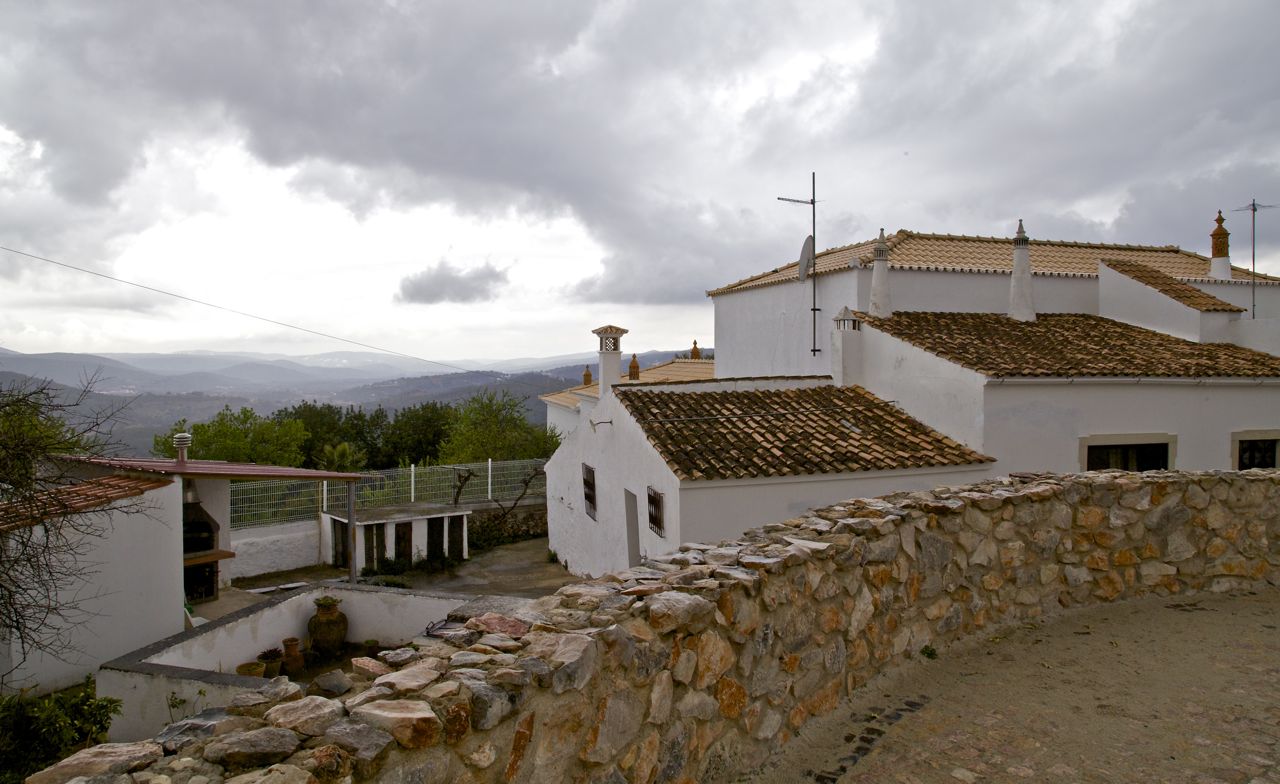
The rain drove us all back to the bus and we moved on to Salir, only a short drive away. The rain abated a bit so we had a bit of a break to look around and get a few photos when we got to Salir.
Most of the buildings, as you can see, are whitewash usually with quite brightly coloured frames around windows and on railings. The colours are quite attractive and the white makes the place look very clean.
This last of my photos from Salir includes a small church - left.
After our brief stay in Salir, we headed for our final stop, Alte, reputed to be the best example of a traditional Portuguese village. Here we had our lunch after which about 45 minutes or so to look around and take some photos.
Adjacent is an image of a kind of plaza in Alte near the restaurant with Ruth (left) on her way to lunch.
This is a small stream or ribeiro (rivulet) that runs through the town. I was told there is a water fall somewhere, though I didn't see it.
As is suggested by the number of photos of Alte, I found it a very attractive village. As in Salir, buildings are well kept and usually white with bits of colour on most.
And you can no doubt appreciate I liked the narrow streets, the colour and the characteristic cobblestone walkways everywhere.
Another of the narrow "streets", this one with blue trim leading one along the cobblestone path; this combination of steps and inclined walkway seemed a common pattern in Alte. Looking along this path makes one wonder what's tucked away in there.
This area of the Algarve is well away from the coast in an area with quite hilly terrain so there is lots of climbing up stairs like these. This was also quite a nice view across the valley to the hills on the other side.
Ruth walking toward the area where we are to meet the bus to head for home.
I can't help wondering how much work and expense it is to keep these villages looking so pristine and how the frequency of tourists affects life there.
After an unexpected hour or so in Loulé, we moved on to Querença. Pretty much the first thing you see in the plaza in front of the church in Querença is a collection of brightly painted cows - examples of same in these photos which Ruth took.
Not sure why they are there and our guide did not enlighten us. These reminded me of the Mel Lastman years as mayor of Toronto when he arranged to have similar representations of moose around the city.
While most of the group were inspecting the church I took a brief stroll near the cow plaza. It was dark and overcast and raining a bit so not very pleasant but I took a few photos to have some impression of the area - one is adjacent.
The rain drove us all back to the bus and we moved on to Salir, only a short drive away. The rain abated a bit so we had a bit of a break to look around and get a few photos when we got to Salir.
Most of the buildings, as you can see, are whitewash usually with quite brightly coloured frames around windows and on railings. The colours are quite attractive and the white makes the place look very clean.
This last of my photos from Salir includes a small church - left.
After our brief stay in Salir, we headed for our final stop, Alte, reputed to be the best example of a traditional Portuguese village. Here we had our lunch after which about 45 minutes or so to look around and take some photos.
Adjacent is an image of a kind of plaza in Alte near the restaurant with Ruth (left) on her way to lunch.
This is a small stream or ribeiro (rivulet) that runs through the town. I was told there is a water fall somewhere, though I didn't see it.
As is suggested by the number of photos of Alte, I found it a very attractive village. As in Salir, buildings are well kept and usually white with bits of colour on most.
And you can no doubt appreciate I liked the narrow streets, the colour and the characteristic cobblestone walkways everywhere.
Another of the narrow "streets", this one with blue trim leading one along the cobblestone path; this combination of steps and inclined walkway seemed a common pattern in Alte. Looking along this path makes one wonder what's tucked away in there.
This area of the Algarve is well away from the coast in an area with quite hilly terrain so there is lots of climbing up stairs like these. This was also quite a nice view across the valley to the hills on the other side.
Ruth walking toward the area where we are to meet the bus to head for home.
I can't help wondering how much work and expense it is to keep these villages looking so pristine and how the frequency of tourists affects life there.
Subscribe to:
Posts (Atom)