Wednesday, March 26, 2014

Wednesday, March 26, 2014

Drew and Julia have been gone a week and we returned  5 days ago from our time in Setúbal and tenancy in the Pousada de São Fiiipe. It's quiet here without Drew and without Julia's wonderfully lively spirit and engaging perpetual motion, so we are, well, resting. We were extremely lucky with the weather while they were here including the day trips to Lisbon (Drew and me) and the western Algarve on which we all went together.
Unforgetable images of Drew and Julia on the beach. Drew actually fully immersed himself twice into the water. Julia was reluctant to get her feet into the water (below she is giving it careful consideration) - in the end she overcame her reluctance.
But, it's back to the daily routines and, as we are in our last week, we are thinking a bit about a few things to do before we go and paying attention to organizing our larder so as to not have too much food to deal with in the count down to departure.
And, of course, included in the "daily routines" are my visits to the beach and my compulsion to make photos of sunsets etc., and put them here, even if they contain blemishes, like this one. 
Hip and foot discomfort have continued to plague Ruth off and on, so this rest period is a good thing. Fortunately, she has found a couple of good sources of books very nearby - one is kind of a loaner arrangement for free and the other is a buy back one - bring it back and he buys it back for less than you paid for it. So, in addition to her kindle books she has a reasonable supply of actual books. And, she has done a bit of drawing and painting, which is great.
We have continued our good fortune with the weather - 3 or 4 days in a row with cloudless skies and temperatures 19 or 20 degrees C or higher! And for the full 5 weeks we have had little if any rain. Good for us, maybe not so good for growing things.
Yesterday, a beautiful warm cloudless day, we went in to old town, Ruth on the bus and me along the beach, mailed some things, bought a few things, you know - "all I got was this T-shirt" - things. Then we had lunch at Sir Harry's pub before coming home.
When I walked the beach it looked like this - the beach manicurists have been beautifying it by getting rid of all those bumpy footprints and troublesome shells that keep washing up on the shore.
Though I am back to my pattern of doing beach photos, I am trying to include a tiny bit of variety. For example, the next two images are "moonsets" in contrast to my all too common sunsets. Not as colourful but beautiful in their own way and kind of serene.
And this view I have not captured before at sunset - if you click on this image, as usual, you will see a larger image and I hope you can then see the reddish cliffs (this is not all caused by the sunset glow - the soil is really quite red), the hills or mountains in the background and the white buildings of the capital city of the Algarve, Faro.

Here is his equipment - can the fisherman be far away?

Ah!  There he is in the fullness of this sunrise.
Thanks to encouragement by Michael, I am once again trying some long exposure photography - still getting the hang of it so nothing to show yet but maybe something different in the next blog post. The fellow who wrote the e paper I am reading about long exposure photography says that when he goes out to capture some long exposure images he anticipates making 500 or more in a couple of hours! - keeping possibly 10 and showing 1. There will be a lot fewer than 500 before one finds its way onto this blog.
What's this? A few minutes ago my fisherman friend was up on the cliff (above) and here he is again - I am beginning to think that he is following me to get into the photo, and, if you look closely, you can see that he has brought his dog into the photo as well.


Monday, March 24, 2014

Last bit on São Filipe Fortress/Castle

Even here it seems I must make photos of the sunrise - this image is supposed to be a complete silhouette but the blog software lightens the photo a bit - not what I wanted but still okay.
A brief word about the Fortress/Castle thing. The terms tend to be used without a clear distinction. This place seems to be referred to here as the "Castle", but it clearly was a fortress, a military structure designed to defend the harbour. One definition of a "castle" is "a large building occupied by a ruler and fortified against attack". Though this structure was built on the direction of the king and he was apparently present when building began, I have seen nothing to suggest that he actually took up residency here. So, I would think fortress rather than castle.
Remember our arrival trip up the long tunnel with the light at the end? This is an image on the way down with a beautiful tile pattern around the arch and the light shining from the entrance doorway into what one might refer to as the "foyer". Somehow I doubt that the tiles around the arch were part of the original fortress but maybe they were.

Now we go back up again and at the upper end of the tunnel that opens near the  terrace, remember?
At the left is the entry to the chapel mentioned in the brief history of the fortress provided in the first post about the São Filipe Fortress/Castle. The chapel is decorated on every inch of space - except the altar - with painted tiles, some of which apparently depict the life of St. Phillip.


In an earlier post I mentioned that, while much of the original structure had been polished up to make it safe and tidy, some areas were left in a fairly weathered and worn condition, somewhat closer to what they had been like after 400 plus years. This stairway to the level above the terrace has the appearance of age that has not seen much renovation. Both the wall and steps are pretty rough and the rise and run of the steps varies substantially so you have to pay close attention when negotiating this avenue up to the top.


And once at the upper level you can slip into one of the corner turrets and from inside this one, through the small entry way, you can catch a glimpse of the inn and terrace area with the unique umbrellas which you will see more of in this post than you likely want!


These umbrellas, which you have seen in earlier posts, are great for shading the lunch area on the terrace, appreciated anytime but no doubt especially in the heat of the summer. But, in addition to providing shade, they have an aesthetic, interesting and appealing arrangement of shapes and curved outlines including the light patterns on the stone where the sun slips through (which you can see in the photo above)

and they are also interesting, at least to me, from above, as in this view from our room window

or this one with the tug boat far down on the water of the Sado river harbour and the tiny boat in the distance - also taken from our room window. This photo was made with a zoom lens so, because zooms compress distances, the tug boat appears much closer than it actually is.

And the last one, I promise, with the early morning sun creating an interesting outline of the umbrellas and a soft glow of light on the harbour through the "window" between the umbrellas and the terrace wall.

You've seen a view a bit like this one - looking southward toward the ocean and the town of Troia, but the flowers in the foreground in this view are, for me, a nice touch of colour and softness - a contrast to the grey stone of the fortress wall. You can also see a bit of the second wall, mentioned in an earlier post, at the base of the outer wall of the fortress. And, in the upper right, you may catch sight of the frequently displayed umbrellas.

And there is the door to our room to which we say good bye and good bye to Pousada de São Filipe, once a Fortress, perhaps in recent times, a Castle.
By the way, São in front of a name means Saint - so, in this case in English, Saint Philip.

Sunday, March 23, 2014

More on São Filipe Fortress/Castle


This is one of two access areas from the inn or terrace level to the upper level of the fortress. When you reach the upper level you find a large expanse of stone (photo below) extending out in several directions. If you noted the schematic of the fortress in the first blog post you will recall that the format was that of a 6 pointed star.


In this image there is a "sentry box" or turret at the far end which is one of the six star points of the fortress and each star point is topped by one of these turrets.

I walked up to that turret in the distance and turned around to face in the direction of the city and harbour and took this photo (actually I took it the next morning at sunrise, hence the orange tint).
If you look closely at this photo on the right, you can see two other similar turrets each of which is on one of the other star points.

The photo below was taken from the same location but looking in a southerly direction toward the Arrabida hills and the ocean and another point on the star arrangement of the fortress. Not sure you can appreciate the star shape from these images but you no doubt get the point, as it were.

Looking over the rather low wall down to the fortress entry area parking lot the size of the cars gives some indication about the height of the outer wall at this location. Here, in the photo below, you can also see a second wall, about 8 meters high, which extends around the fortress forming a barrier to attack, though I have no idea if they added water to increase its effectiveness as a defence against intrusion.


From the ground you can certainly see in the image to the left the very distinct point of this section of the fortress complete with the turret perched at the top.
And this view from the ground gives a pretty good perspective on the height of the outer walls as well as the tenacity of plants that grow in any nook and cranny that the walls provide!


Here we are looking north just after sunrise so there is a nice glow on the fortress wall. At the base of the outer fortress wall is the second wall which surrounds the fortress and which we saw in the image of the parking area on the westerly side.

There are so many great vantage points for photos, especially in this morning light on our first full day. This was definitely the best light for photography while we were there. Check out the red flowers growing out of the wall.

So, in the early morning when there was no one else around I spent a good deal of time poking around to look for what I hoped would be interesting light and points of view which might convey the ambiance of the place and this spectacular morning.
The above and the next few images are the result of my meandering search that morning.

In the first post about the castle I mentioned some entry ways to enclaves below the upper level which were open and accessible - the image to the left was made at the entrance to one of those places.


And after descending a dozen or so quite steep and narrow steps I was in a tiny "room" which looks out through the arched opening, in the photo to the right, toward the town and the harbour.
This is the stairway leading out of this space and when I got to the top and looked out through the doorway I saw the this image (below) of the expanse of stone floor, the tower and a glimpse of the harbour beyond. For me these last six images convey, through small windows, some of the character and mystery of this place.

A few more photos to come.

Saturday, March 22, 2014

Setúbal and São Filipe Fortress/Castle


Our first image of the Pousada
Here we are in our second and last night in Setúbal and, because we didn't think about it carefully enough, it has been a far different experience than we anticipated. (The trick with this post is that you need to read the commentary or the images will make no sense and, as always, for a larger image click the on the photos.)
You may recall from my second post this year that we learned of the wonders of Setúbal from a fellow we met through an iPad discussion at the Toronto airport. So, given that we were unable to organize a Douro river cruise, we decided that Setúbal would be our adventure this year. 
Only way in to the Inn
When we mentioned it to Ana, our JMV contact, she gave it high marks as well, so we made the arrangement. And, as this would be a 3 day experience, when it came time to choose a place to stay the option of the São Filipe Pousada came up and we decided we would go all out and stay in the castle/fortress, which is what São Filipe Pousada was in the late 1500's. There were a few things, however, that we failed to take into consideration when we made all these decisions. For example, the São Filipe Pousada is situated high, and I do mean high, (about 500 meters according to the Lonely Planet book) above the city, so there would be no walking up and down from the castle to town (which by the way is a city of over 100,000 and a "suburb" of Lisboa). Secondly, the castle is a couple of Km from the downtown area so more walking than Ruth can do easily, even if there was not a substantial hill in the equation. 
Turn right
Thirdly, Setúbal is a fairly large modern city, so there is really not much of interest that is easily accessible - what we had heard is that there are wonderful beaches, wonderful water vistas and the Arrabida Nature preserve is nearby and it would be a wonderful place to visit - that is if a lot of walking is possible, which it is not.  In short, our iPad information source must have had a car thus able, with ease, to nip around to all these, no doubt, terrific places.
So, after seeing Drew and Julia off at 5 am on Wednesday, we left "home" at 9 am in a taxi bound for the train station, successfully navigated the ticket purchase and train ride including the unexpected transfer to another train in Pinhal Novo and arrived in Setúbal pretty much as scheduled.
Long uphill tunnel
As we arrived in the city some of the obvious problems regarding getting around in Setúbal began to dawn on us, especially when we took our taxi trip to the Pousada. But the real "piece de resistance" appeared after the drive up the long steep climb and we arrived at the Pousada! At least that is what the sign said (see first photo).
Exit from the tunnel
Is this really it? It looked a lot like it was still a 16th century fortress. There was only one way to go so, though it looked most unlikely to be the way to the place we would be staying, we pressed on. Even as we made our way along into the dimness on very rough cobblestones, and uneven steps that definitely looked like they belonged in a fortress, I remained doubtful that this was the right way to the Pousada, and, if it was, coming here was a big mistake. 
This must be it
We continued on up the stairway toward the light at the end of the tunnel, as it were. When we reached the light, there it was - the sign saying "Pousada". We really were in the right place. We turned right as instructed, went up a few more rugged stone steps onto a very large organized patio or terrace 
which provides an amazing view of the city,the immense Sado river harbour and the Arrabida hills and nature preserve in the distance with just a glimpse of the ocean beyond.

Spectacular! The image below is the immense Sado river harbour - more photos of the views to come.
Sado river harbour
And there was the Pousada entrance with the sign confirming that this was the São Filipe Pousada. 
The Reception office was tiny and signing in was uncomplicated, facilitated by the extremely friendly and helpful staff. They had been able to "upgrade" us to a harbour/ocean view room on the 3rd floor - and as there are no elevators or escalators - more stair climbing! 
Stairs to the 1st floor
 It was, by now, becoming clear to us that, given Ruth's walking limitations, there would be no visits to town or elsewhere for that matter - our adventure would be a relaxing time in this extraordinary place with good food, good beds, an awesome view and major photo opportunities! We soon realized that the decision to stay at the Pousada was the best decision we had made concerning our visit to Setúbal!
Up to the 2nd floor
I know people have, for centuries, been building large and impressive structures like this huge fortress, but how they did it never ceases to amaze me. And, I have never been in such intimate prolonged contact with such a place before, so this experience makes the question even more compelling - how to amass all of the rocks and other materials and raise walls 1/2 to 1 meter thick stacked 25 or 30 meters or more high around the equivalent of a town with all the necessary inner structures with only man power, ingenuity and engineering expertise and no fossil fuel driven power equipment? Amazing!
Inn and town of Troia in the distance 
The places we are permitted to go are a mix of very old, some spruced up a bit and some seemingly original modified only enough to make them safe (see comment below re safety), and some definitely 20th century. Wandering around the upper part of the fortress one finds a few openings and stairways to small enclaves beneath the stone surface that can be explored and a number of other mysterious "no entry" openings as well.
Morning on the river harbour 
At the bottom of one prohibited stairway there are some very large doors, suggesting that there is a lot of space down there below the inn. We also caught a glimpse through a usually closed doorway of an extensive passageway, obviously in use, extending off the "tunnel" en-route to the inn level but well below that level. How much there is beneath the inn level, however, remains a mystery to us. It is very nice to have access to much of the old fortress at and above the inn, but I was a bit surprised at some of the upper areas where we are permitted to go, which seem to me to be potentially unsafe -  for example, some lowish walls around areas quite a bit higher than the level on the other side of the wall. Even the outer walls are only about 3.5 to 4 ft. high and it's a long way down on the other side!
Lunch under the unique umbrellas
with an amazing view
The Inn itself, of course, is essentially new with traces of "spit and polished", possibly original structures - like the stone steps from the entry hall up to the first floor and possibly even some of those to the second floor. The steps to the third floor are clearly of the 1960's or later (the "conversion" to the inn began around 1965).
For us, during the roughly 2 days we spent here, there was much reading and making photos, both recording the original image and processing the raw version, writing the blog and, of course, eating, napping and sleeping. 
The Pousadas (of which there are around 8 in Portugal) are, we were told, publicly owned and operated. In terms of guest rooms it is a small place - 16 rooms - so it is quiet, the staff are very friendly and quickly get to know you.
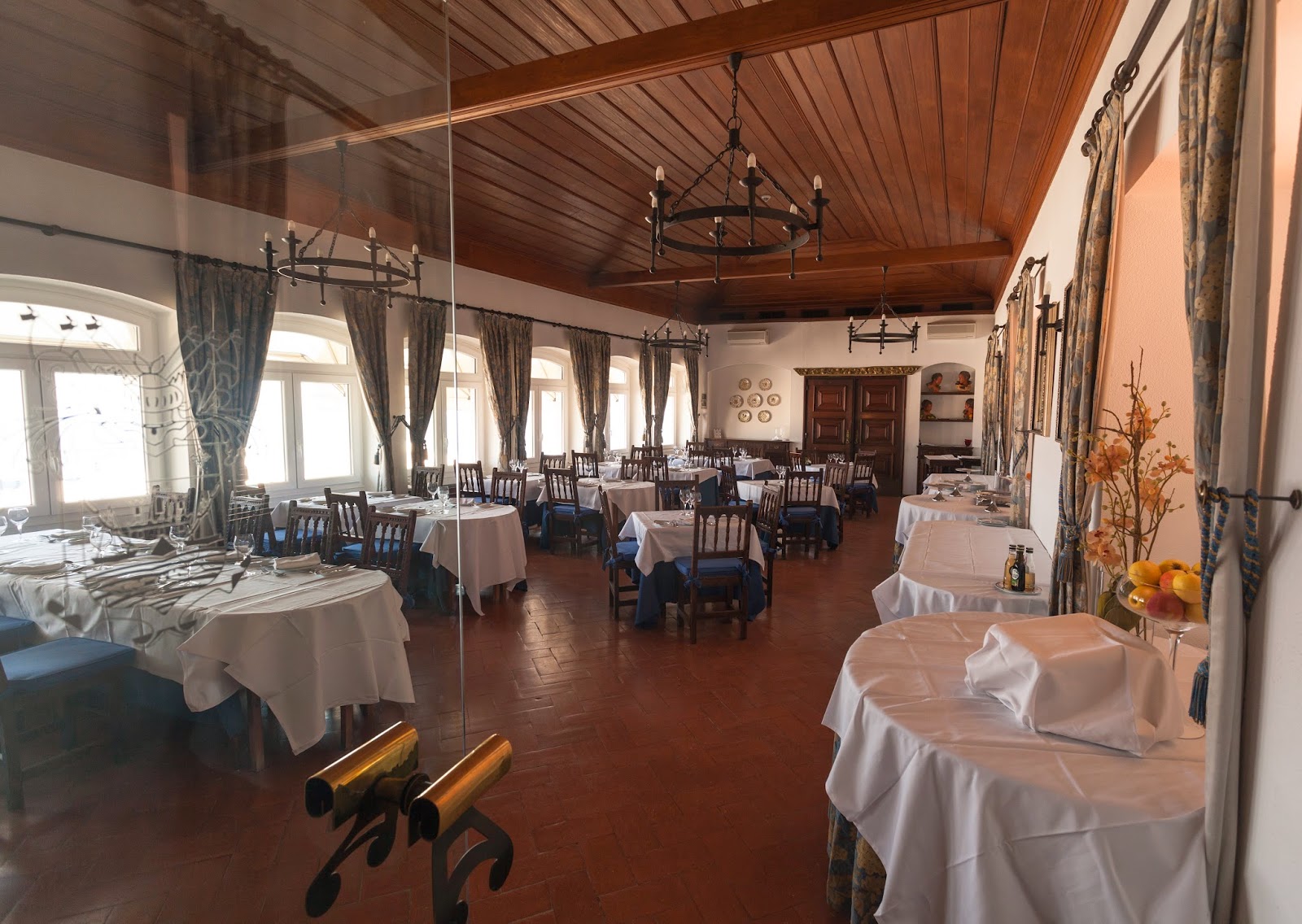
Place for breakfast and dinner
 The price of the room includes breakfast, which is excellent. Lunch and dinner are available and the food is good but fairly pricey (on our first day, before we learned the ropes, we paid 42 Euros - about $60 - for lunch!) but the price of meals includes 23% tax! That's the Portuguese way - they tax luxuries (a good thing, in my view) and this place is definitely in the luxury category. 
Brief history of the fortress
Now it is Friday and we have come to the end of our very interesting and enjoyable stay at Pousada de São Filipe . We will leave at noon and try to find the correct train back to Pinhal Novo where we transfer to the train to Albufeira. Wish us luck!

Schematic of the original fortress
We made it with a couple of bits of helpful guidance and are now back in our apartment.

Many more images to come!