Sunday, March 23, 2014

More on São Filipe Fortress/Castle


This is one of two access areas from the inn or terrace level to the upper level of the fortress. When you reach the upper level you find a large expanse of stone (photo below) extending out in several directions. If you noted the schematic of the fortress in the first blog post you will recall that the format was that of a 6 pointed star.


In this image there is a "sentry box" or turret at the far end which is one of the six star points of the fortress and each star point is topped by one of these turrets.

I walked up to that turret in the distance and turned around to face in the direction of the city and harbour and took this photo (actually I took it the next morning at sunrise, hence the orange tint).
If you look closely at this photo on the right, you can see two other similar turrets each of which is on one of the other star points.

The photo below was taken from the same location but looking in a southerly direction toward the Arrabida hills and the ocean and another point on the star arrangement of the fortress. Not sure you can appreciate the star shape from these images but you no doubt get the point, as it were.

Looking over the rather low wall down to the fortress entry area parking lot the size of the cars gives some indication about the height of the outer wall at this location. Here, in the photo below, you can also see a second wall, about 8 meters high, which extends around the fortress forming a barrier to attack, though I have no idea if they added water to increase its effectiveness as a defence against intrusion.


From the ground you can certainly see in the image to the left the very distinct point of this section of the fortress complete with the turret perched at the top.
And this view from the ground gives a pretty good perspective on the height of the outer walls as well as the tenacity of plants that grow in any nook and cranny that the walls provide!


Here we are looking north just after sunrise so there is a nice glow on the fortress wall. At the base of the outer fortress wall is the second wall which surrounds the fortress and which we saw in the image of the parking area on the westerly side.

There are so many great vantage points for photos, especially in this morning light on our first full day. This was definitely the best light for photography while we were there. Check out the red flowers growing out of the wall.

So, in the early morning when there was no one else around I spent a good deal of time poking around to look for what I hoped would be interesting light and points of view which might convey the ambiance of the place and this spectacular morning.
The above and the next few images are the result of my meandering search that morning.

In the first post about the castle I mentioned some entry ways to enclaves below the upper level which were open and accessible - the image to the left was made at the entrance to one of those places.


And after descending a dozen or so quite steep and narrow steps I was in a tiny "room" which looks out through the arched opening, in the photo to the right, toward the town and the harbour.
This is the stairway leading out of this space and when I got to the top and looked out through the doorway I saw the this image (below) of the expanse of stone floor, the tower and a glimpse of the harbour beyond. For me these last six images convey, through small windows, some of the character and mystery of this place.

A few more photos to come.

Saturday, March 22, 2014

Setúbal and São Filipe Fortress/Castle


Our first image of the Pousada
Here we are in our second and last night in Setúbal and, because we didn't think about it carefully enough, it has been a far different experience than we anticipated. (The trick with this post is that you need to read the commentary or the images will make no sense and, as always, for a larger image click the on the photos.)
You may recall from my second post this year that we learned of the wonders of Setúbal from a fellow we met through an iPad discussion at the Toronto airport. So, given that we were unable to organize a Douro river cruise, we decided that Setúbal would be our adventure this year. 
Only way in to the Inn
When we mentioned it to Ana, our JMV contact, she gave it high marks as well, so we made the arrangement. And, as this would be a 3 day experience, when it came time to choose a place to stay the option of the São Filipe Pousada came up and we decided we would go all out and stay in the castle/fortress, which is what São Filipe Pousada was in the late 1500's. There were a few things, however, that we failed to take into consideration when we made all these decisions. For example, the São Filipe Pousada is situated high, and I do mean high, (about 500 meters according to the Lonely Planet book) above the city, so there would be no walking up and down from the castle to town (which by the way is a city of over 100,000 and a "suburb" of Lisboa). Secondly, the castle is a couple of Km from the downtown area so more walking than Ruth can do easily, even if there was not a substantial hill in the equation. 
Turn right
Thirdly, Setúbal is a fairly large modern city, so there is really not much of interest that is easily accessible - what we had heard is that there are wonderful beaches, wonderful water vistas and the Arrabida Nature preserve is nearby and it would be a wonderful place to visit - that is if a lot of walking is possible, which it is not.  In short, our iPad information source must have had a car thus able, with ease, to nip around to all these, no doubt, terrific places.
So, after seeing Drew and Julia off at 5 am on Wednesday, we left "home" at 9 am in a taxi bound for the train station, successfully navigated the ticket purchase and train ride including the unexpected transfer to another train in Pinhal Novo and arrived in Setúbal pretty much as scheduled.
Long uphill tunnel
As we arrived in the city some of the obvious problems regarding getting around in Setúbal began to dawn on us, especially when we took our taxi trip to the Pousada. But the real "piece de resistance" appeared after the drive up the long steep climb and we arrived at the Pousada! At least that is what the sign said (see first photo).
Exit from the tunnel
Is this really it? It looked a lot like it was still a 16th century fortress. There was only one way to go so, though it looked most unlikely to be the way to the place we would be staying, we pressed on. Even as we made our way along into the dimness on very rough cobblestones, and uneven steps that definitely looked like they belonged in a fortress, I remained doubtful that this was the right way to the Pousada, and, if it was, coming here was a big mistake. 
This must be it
We continued on up the stairway toward the light at the end of the tunnel, as it were. When we reached the light, there it was - the sign saying "Pousada". We really were in the right place. We turned right as instructed, went up a few more rugged stone steps onto a very large organized patio or terrace 
which provides an amazing view of the city,the immense Sado river harbour and the Arrabida hills and nature preserve in the distance with just a glimpse of the ocean beyond.

Spectacular! The image below is the immense Sado river harbour - more photos of the views to come.
Sado river harbour
And there was the Pousada entrance with the sign confirming that this was the São Filipe Pousada. 
The Reception office was tiny and signing in was uncomplicated, facilitated by the extremely friendly and helpful staff. They had been able to "upgrade" us to a harbour/ocean view room on the 3rd floor - and as there are no elevators or escalators - more stair climbing! 
Stairs to the 1st floor
 It was, by now, becoming clear to us that, given Ruth's walking limitations, there would be no visits to town or elsewhere for that matter - our adventure would be a relaxing time in this extraordinary place with good food, good beds, an awesome view and major photo opportunities! We soon realized that the decision to stay at the Pousada was the best decision we had made concerning our visit to Setúbal!
Up to the 2nd floor
I know people have, for centuries, been building large and impressive structures like this huge fortress, but how they did it never ceases to amaze me. And, I have never been in such intimate prolonged contact with such a place before, so this experience makes the question even more compelling - how to amass all of the rocks and other materials and raise walls 1/2 to 1 meter thick stacked 25 or 30 meters or more high around the equivalent of a town with all the necessary inner structures with only man power, ingenuity and engineering expertise and no fossil fuel driven power equipment? Amazing!
Inn and town of Troia in the distance 
The places we are permitted to go are a mix of very old, some spruced up a bit and some seemingly original modified only enough to make them safe (see comment below re safety), and some definitely 20th century. Wandering around the upper part of the fortress one finds a few openings and stairways to small enclaves beneath the stone surface that can be explored and a number of other mysterious "no entry" openings as well.
Morning on the river harbour 
At the bottom of one prohibited stairway there are some very large doors, suggesting that there is a lot of space down there below the inn. We also caught a glimpse through a usually closed doorway of an extensive passageway, obviously in use, extending off the "tunnel" en-route to the inn level but well below that level. How much there is beneath the inn level, however, remains a mystery to us. It is very nice to have access to much of the old fortress at and above the inn, but I was a bit surprised at some of the upper areas where we are permitted to go, which seem to me to be potentially unsafe -  for example, some lowish walls around areas quite a bit higher than the level on the other side of the wall. Even the outer walls are only about 3.5 to 4 ft. high and it's a long way down on the other side!
Lunch under the unique umbrellas
with an amazing view
The Inn itself, of course, is essentially new with traces of "spit and polished", possibly original structures - like the stone steps from the entry hall up to the first floor and possibly even some of those to the second floor. The steps to the third floor are clearly of the 1960's or later (the "conversion" to the inn began around 1965).
For us, during the roughly 2 days we spent here, there was much reading and making photos, both recording the original image and processing the raw version, writing the blog and, of course, eating, napping and sleeping. 
The Pousadas (of which there are around 8 in Portugal) are, we were told, publicly owned and operated. In terms of guest rooms it is a small place - 16 rooms - so it is quiet, the staff are very friendly and quickly get to know you.
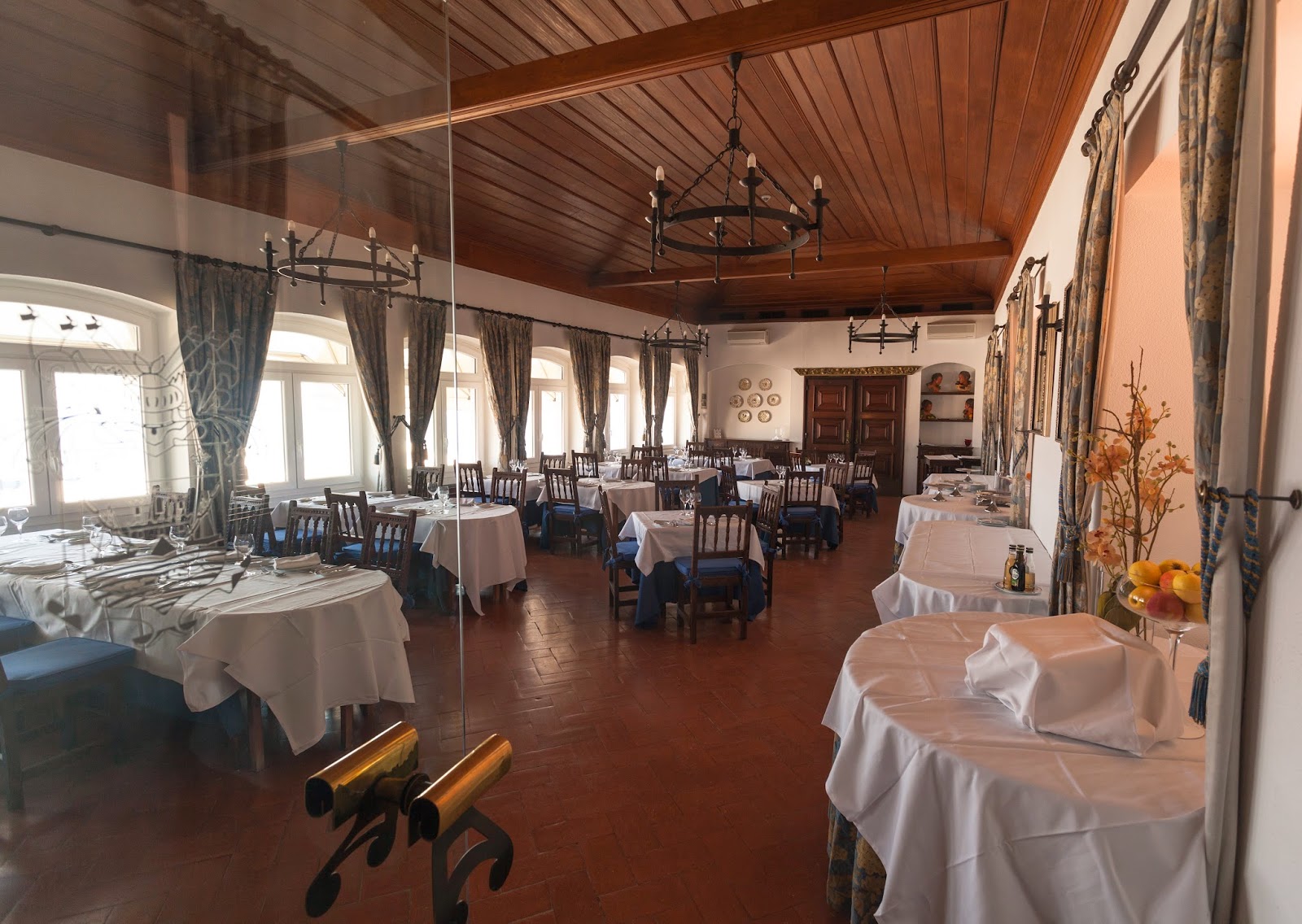
Place for breakfast and dinner
 The price of the room includes breakfast, which is excellent. Lunch and dinner are available and the food is good but fairly pricey (on our first day, before we learned the ropes, we paid 42 Euros - about $60 - for lunch!) but the price of meals includes 23% tax! That's the Portuguese way - they tax luxuries (a good thing, in my view) and this place is definitely in the luxury category. 
Brief history of the fortress
Now it is Friday and we have come to the end of our very interesting and enjoyable stay at Pousada de São Filipe . We will leave at noon and try to find the correct train back to Pinhal Novo where we transfer to the train to Albufeira. Wish us luck!

Schematic of the original fortress
We made it with a couple of bits of helpful guidance and are now back in our apartment.

Many more images to come!


Tuesday, March 18, 2014

Silves, Monchique, Lagos and Cape St. Vincent


When the bus stopped to pick us up at 8:20 am Sunday we found that our guide for the trip was Luis, our guide two years ago when we went to Gibraltar and Morocco, so we knew we were "in good hands" for this trip!
Our first stop was at a "photo" spot just outside the town of Silves. From here we had a good view of the remains of the fortress that was built by the Moors in the mid 11th century. Remember to click on the photos.
Silves, on the Rio Arade, had been a successful commercial city even before the Romans occupied this area. After the Moors conquered much of the Iberian peninsula in the 8th century Silves became an important maritime trading and industrial city, rivalling Lisboa. When the city was invaded by the Christians from the north, the Moors were able to hold out in the fortress for 3 months, but when their giant cistern, which apparently held over a million gallons of water, ran dry, they were defeated and driven out of the city.
Drew (far end) in the giant cistern
The prominence of the city declined for several reasons including the loss of the trade established by the Moors, the silting of the Arade river which prevented ships from moving inland, the accessibility of other ports on the Algarve coast and later, the 1755 earthquake which destroyed much of what remained. In the 19th century the cork industry revitalized the city temporarily (apparently at one time there were over 50 cork plants in Silves of which, our guide said, none remain).
"Artsy" image from inside
 one of the towers.
The "castle" or fortress, abandoned in the 16th century, declined until recent years when restoration began and is ongoing,  including archaeological exploration of ruins from Roman and earlier periods.
Algarve coast in mist from Fòia peak
From Silves we went inland to the village of Monchique which is about 400 meters above sea level in the Algarve mountain range, Serra de Monchique. We passed through the village on our way to the Fòia peak, the highest point in the Algarve at 902 meters above sea level. Here our guide pointed out the view, in the distance, of Portugal's southern and western Atlantic ocean coasts which meet at the Cape of St. Vincent once known as "lands' end", the most southerly and westerly point of Europe.
At Fòia peak
Not surprisingly, there was a shop here at Fòia peak selling handicrafts, including sweaters, ponchos and blankets and, of the latter, we purchased a colourful one. Luis took orders for lunch and called them in to a restaurant in the town of Monchique in order to shorten the time for lunch. 
At Monchique


After photo ops, shopping and sampling, by some, of the local medronho (locally referred to as moonshine or firewater) we drove down to the restaurant for lunch. Then, on to Lagos.
Lagos, on the south coast of the Algarve at the mouth of the Bensafrim river, is an historically important city. Once occupied by the Phoenicians, Greeks, Romans and Moors it was re-conquered from the Moors by the Christians in 1241. And from Lagos in 1415 a large fleet, led by Prince Henry the Navigator, sailed south to Africa in his Caravels, (apparently built in Lagos) smaller and faster ships better able to sail the Atlantic waters than other ships of the time, and they returned with "loot" and stories of discovery. This adventure, in a way, launched the so called Age of Portuguese discoveries and the beginning of the first and largest of the European empires.
Lagos - Henry the Navigator Plaza
Soon ships were returning to Lagos with their riches of gold, ivory and slaves. In 1444 Lagos hosted the first auction of black Africans as slaves and Lagos grew into one of the slave trading centre in Europe - the slave auction site remains in Lagos. We opted to leave the tour group and stroll around on our own visiting the Praça Infante Henrique, Navigator, the site of the slave market and then on to the walls of the old Moors' walled city. 
At Cape St. Vincent

In the photo above, the slave auction area is at the far end of the plaza on the right.
Then we went to an old embattlement that was used to guard the entrance to the harbour. Physiology called once more necessitating a search for a WC, which we found quite quickly. The enemy, time, was once more threatening so we made our way back to the bus pick up area from which we set out for the town of Sagres and "lands' end" or Cape St. Vincent. (Oddly enough, St. Vincent, the patron saint of Portugal, was a Spaniard). 
Western coast at Cape St. Vincent
Here at Cape St. Vincent is, we are told, the most powerful light house in Europe which apparently can be seen from over 70 Km away. The Cape is, as I mentioned, the most southerly and westerly point of Europe and there is nothing there except the incredible natural beauty of this rather desolate but awesome point of land rising, I'm guessing, at least 200 ft from the Atlantic Ocean. The photos, I hope, tell the story!
South coast at Cape St. Vincent


It was a great day and now the roughly 2 hour ride back to Albufeira.


Monday, March 17, 2014

Saturday with Drew and Julia

View out one of Drew
& Julia's windows

This was a very quiet, relaxing day. It was sunny and warm so mid morning Julia, Drew and I walked on the beach into old town Albuferia while Ruth rode the bus. We were on a mission to The Three Crowns for lunch. When we reached the Three Crowns we were disappointed to find that the ocean overlook part of the restaurant was closed for about an hour for cleaning.
We went looking for another restaurant with an ocean view but they were all closed until noon. Just outside one of the restaurants we noticed an orange tree and discovered, what none of us had realized - orange trees have large thorns! Must make harvesting oranges a bit tricky.
Since the restaurants were not open yet we decided to go to a small cafe for a drink before resuming our restaurant search. After drinks we checked out a restaurant that was open but we didn't care for the ambiance and couldn't find anything on the menu for Julia.
Julia in the rejected restaurant
By this time nearly an hour had passed so we decided we would try the Three Crowns again and we were in luck and we had a nice lunch under umbrella shade.


At the Three Crowns
Since Drew felt that Julia's "cough and cold" seemed to be persisting he decided that she should have rest, especially since tomorrow would be a long day. 
On the way home after lunch
So we set out for home, three of us on the beach and Ruth on the bus.
The "rest" project was only partially successful, achieving a bit of relative quite time but not actual sleep.
On the way home after
lunch


After "rest time" Julia and Ruth spent some time on crafts and games while Drew and I did a bit of grocery and bakery shopping. On the way home we stopped to sample a Super Bock draft and make reservations for dinner at the Panacee. At 6:30 we went to dinner and the meal included the usual pasta for Julia, fresh Salmon steaks for Ruth and Drew and fresh Golden Bream for me, a bit of wine and some port wine to end the meal, courtesy of the Panacee.
Going home through
old town after lunch

Home to bed right after dinner as tomorrow will be a long day for our trip to Silves, Monchique, Lagos and "lands end" - Cape St. Vincent.