Tuesday, February 5, 2013

Cuba - Day 12 - January 14th

More "housekeeping" today. Aglaes, our host, volunteered to go with us to the bus station to get our tickets to Varadero. So, after breakfast we went to the bus station where, thankfully, she guided us through the process of getting our tickets much more easily and quickly than we could have done on our own (the place is bereft of signage - a little like the Toronto airport).

Off to the bank for money exchange, which also went smoothly.

At the tourist place we booked a 2 hour boat tour of the Bay for this afternoon and a trip to the Parque el Nicho for tomorrow. The latter, which all of our Cuban contacts say is a beautiful nature experience, is a full day outing so we are scheduled depart from Hotel La Union at 8 am.

Remember the truck transport vehicles, los camions, I mentioned in an earlier blog? It was these that came to mind when the woman at the tourist place mentioned, casually, that, at the pick up area, we would be getting on the "truck" for the trip to El Nicho. Of course, we concluded, she mis-translated truck for bus.

With those bits out of the way we thought we would have a sip of something at an outdoor bar and we both thought the waiter's suggestion of sangria sounded perfect. After our first sip we both realized that, in view of the persistent low grade symptoms we were both experiencing, this drink was not the best choice so we abandoned the sangria for water.

We did a quick tour of the small handicraft store on the plaza then went back to our casa to pick up some sun screen for the boat tour of the bay after lunch. We calculated that we could walk to La Aché, have lunch and easily arrive for the tour precisely on time. Which we did.

We had been told that the tour would be 2 hour and it would take us all around the bay, neither of which proved accurate. It lasted just under an hour and covered about a quarter of the bay shoreline - in short, it was a complete flop (well, almost complete) . Bob was determined to visit the tour ticket place to inform the woman of our dissatisfaction and to request a partial refund which he did later, resulting in a 5 CUC (25%) refund!
Cienfuegos Club
The reason they gave for the brevity of the outing was that the bulk of folks on that particular bay tour were members of group of German tourists who had only an hour available. So they abbreviated the tour for them and slipped us into that group presumably thinking we would just accept it - but they didn't count on the tenacity of Bob James to call them to account!

After the boat tour disappointment we walked down to the southern part of the Punta Gorda isthmus to check out the area past the hotel we had visited a day or so ago.


On the way we discovered an interesting little park with several large whimsical sculptures that we were happy to have found and speculated that the sculptors must have had fun creating these. You can't tell from this photo, but the meat grinder is about 12 feet tall!


Punta Gorda


The walk to the end of the isthmus took us to a small park and a gazebo like structure we had seen from the ferry (far right in this photo) and from this location there was a nice view of the bay with the mountains, where we are going tomorrow, in the distance (below).
An hour after starting for home we arrived at our casa both pretty tired and ready for some rest and another tasty meal by Fabio - and he did not disappoint.


That evening Bob's toe was quite sore - a problem that not only persisted but became more uncomfortable in the coming days. 

Cuba - Day 11 - January 13th


Today is our moving day so time to say our au revoir to Amed and Ines and pay our bill, which, it turns out, was amazingly low! Our host, Amed, was kind enough to walk us to our new place on the Prado.

Casa 1935 - Fabio y Guilda is spacious (in some places the ceilings go up forever!), very clean and our hosts seem welcoming and friendly. Who is that guy in our doorway?

We have an ample bedroom, a kind of sitting room and a patio just outside our room and we have already been promised soup and fresh fish for dinner so we are well situated.

This photo is the "sitting room" just outside our bedroom. I don't know if the height of the ceiling can be appreciated, but it is at least 12 feet high, possibly 14! And note the slightly incongruous fluorescent light hanging a bit precariously from the ceiling fixture by electrical wires and a chain.

And, while on the subject of things like electrical wires - can I add plumbing? Except for the hotel, there is a conspicuous absence of sink and shower hot water taps in bathrooms here, including both the casas in which we have lived.  There is hot water in the showers provided by a rather large shower head device which is also a hot water heater - a mechanism for heating the water on demand, which, in principle, is a very good idea. What is a bit unsettling, however, is the visible electrical wiring at the top of this unit which, along with one's imagining of the potential consequences if water and electrical current came in contact with each other while one is showering, gives one pause.  This arrangement provides a reasonable shower albeit with somewhat unpredictable temperature and pressure (the pressure is only as great as the height of the building can provide since, as I mentioned in an earlier post, it appears that water has to be pumped up to a tank on the roof to provide the pressure) and a slight concern about the potential for an electricity-water mixture.

To give a bit more info about our new place, this is the "patio" area just outside our room which is through the closest set of louvered doors to the right along the walkway. As you can see, it is roofless (well not totally) and at the far end above is a spiral staircase to where?  We have no idea what is up on the second floor or the floor - if there is one - to which the spiral staircase leads.  The kitchen and dining area are through the far doorway and there is more to this dwelling that we never did see.

After resting (even napping) we decided to go out for some lunch and to check out the bank location and to find the bus station.

We found the bank (closed because it is Sunday) that the Lonely Planet book says provides the best exchange value and duly noted its location.

A check on the internet locations but they have no cards (for User ID and password) so we are out of luck - a problem we have encountered before. So, we went to the restaurant in the hotel for some lunch.

After lunch we went to check out the bus station from which we will leave for Varadero on the 21st to catch our flight to Toronto on the 22nd.  We found the bus station about 6 or 7 blocks from the plaza and, I confess that I was more distressed at the conditions than I was expecting. It is rather run down, darkish and quite unkempt and the bus schedule, a chalk board in the basement departure area, gave extremely little information and none at all about buses to Varadero. Quite depressing. So, tomorrow we will have to go back to the tourist information kiosk to try to get some clarification about the bus. It's Cuba - nothing seems to be completely straight forward, at least by our standards.

Back at our new home we sat in the patio area for a very pleasant, getting to know you kind of visit, with our hosts, Aglaes, who speaks English quite well, and her husband, Fabio whose English is like my Spanish - close to zero. Fabio's father, Fabio senior, shares the place with them. They also have a delightfully engaging nearly 4 year old daughter, Fabiaglaes (I think - a combination of their names). She quickly became very friendly, especially with Bob, regaling us with conversation - in Spanish, of course, and though we didn't understand the words it didn't really seem to matter to her. In time, Bob began to understand bits and these moments gave the appearance, at least, of two way conversations.
 
Fabio, we were told, is a chef so the meals, once again, promise to be very good and, generally, they were, though much more food than I was able to eat - yet.  And all meals were accompanied by music and served proudly with a smile and, a bit later, the question - "Good?".  Fabio diligently started the CD player at the beginning of each dinner providing a range of music, no doubt carefully selected. It was a very friendly family ambience made more so by Fabiaglase frequently passing through the dining room and pausing to share her stream of thoughts with us until Fabio noticed her and encouraged her to leave us.

Sunday, February 3, 2013

Cuba - Day 9 and 10 - January 11th and 12th


January 11,  was a day for some "housekeeping" including getting Bob's glasses fixed and picking up our concert tickets at the Teatro.


From the theatre we walked down to the water front on our way to lunch at the paladar La Aché, which was highly recommended by the Lonely Planet folks.

On the way we passed this amazing tree which we have still not identified.


The photo to the right looks across the bay to an area which we plan to visit in the next few days, a trip which proved to be quite interesting.
At the paladar Aché the ambience was pleasant  and both the service and the food were very good, though I say that about the food without much basis as I am still being very careful about what and how much I eat. Bob is feeling much improved so he had a more complete meal and pronounced it very good.

After lunch we went home hoping Amed had found us a new place to check out but he hadn't. He did, however, have some good suggestions of places we might like to explore in the coming days.

January 12th.  Today is our last day at our current Casa and, in the morning, we still do not know where we will go next. After breakfast, we went with Amed to a possible new place quite nearby. This place was certainly acceptable but the owner, unfortunately, speaks virtually no English so we had to look further.

Amed went off on his own errands and we went to the internet cafe for Bob to check his email as he was waiting for something important, then to a restaurant for some fluids and, as neither of us is completely well yet, we are off beer and into juices and water.

Then back to our casa for a bit of a rest before checking out the next possible place for us to stay. This one, which is on the Prado nearer to the central Plaza de José Marti, turned out to be acceptable to both of us so we now had our digs and it was a relief to know where we were going to be for the rest of our time here. More about our new hosts and the accommodation later.

With that settled, we decided to walk down to the water and along the malécon to La Punta Gorda (punta means "point") which is on an isthmus  that extends into the bay area in the southern part of Cienfuegos, a walk of about 1 to 1.5 kilometres.

This area is definitely more middle class with a lot of new and well maintained houses, many Casa Particulares and at least a couple of very upscale hotel, as well as the rather exclusive looking Cienfuegos Club (below).


We stopped for some juice at one of the hotels and sat where we could look out over the bay and harbour.

If you click on the photo to the left and look carefully you should be able to make out a dome like structure on the horizon. This is part of the joint Soviet and Cuban nuclear village and power plant project which, near completion, was halted and "mothballed" under pressure from the US (and likely other countries). It is not accessible, even for us.

Next to the hotel where we drank our juice, there is a building, originally an ostentatious home, now a restaurant. It was built by an extremely rich fellow who apparently died a year or two after the building was completed. It appears to me that it was designed with the Alhambra in mind.
This is not the first Moorish architecture we have seen in Cuba - remember images from Havana with Moorish arches in the Plaza de Catedral as well as the tile work in both the Hotel Sevilla and the Hotel Parque Central - but it is definitely the most spectacular.

During our walk home a lovely sunset was developing, so we stopped a couple of times for pictures.
We were pretty tired after the walk so rested a bit before dinner after which we left, with our host, Amed, for the Teatro for a concert. This was a special event as the string orchestra, The Northwest Sinfonietta Orquesta de camera, was comprised of a group from Seattle with other players from Cuba and a conductor from France. And it was an excellent program with a mix from Carmen to Vivaldi ending with Beethoven's fourth piano concerto with string accompaniment. Both soloists, a woman violinist from Seattle, and the pianist, Joel Fan, were extremely good.

Saturday, February 2, 2013

Cuba - Day 8, January 10th


We are both still not well so activities are curtailed by the need to stay reasonably close to a bathroom and due to, speaking for myself, fatigue related to dehydration and almost zero calorie intake since this GI upset began.
So we spent the morning relaxing in our new home. The roof top access gave us a nice view over this area of the city and of the life on the roof which includes drying clothes and storing water for their homes in large, usually plastic, containers.

In the distance in the above photo you can just see the harbour and the dome to the right is the Palacio de Gobierno, the home of the provincial government.

A reminder to click on any photo to view a larger image.


Bob was very partial to this roof top feature and spent some time reading there.  I thought it was too hot, even mid morning, so didn't join him, except to record the scene.

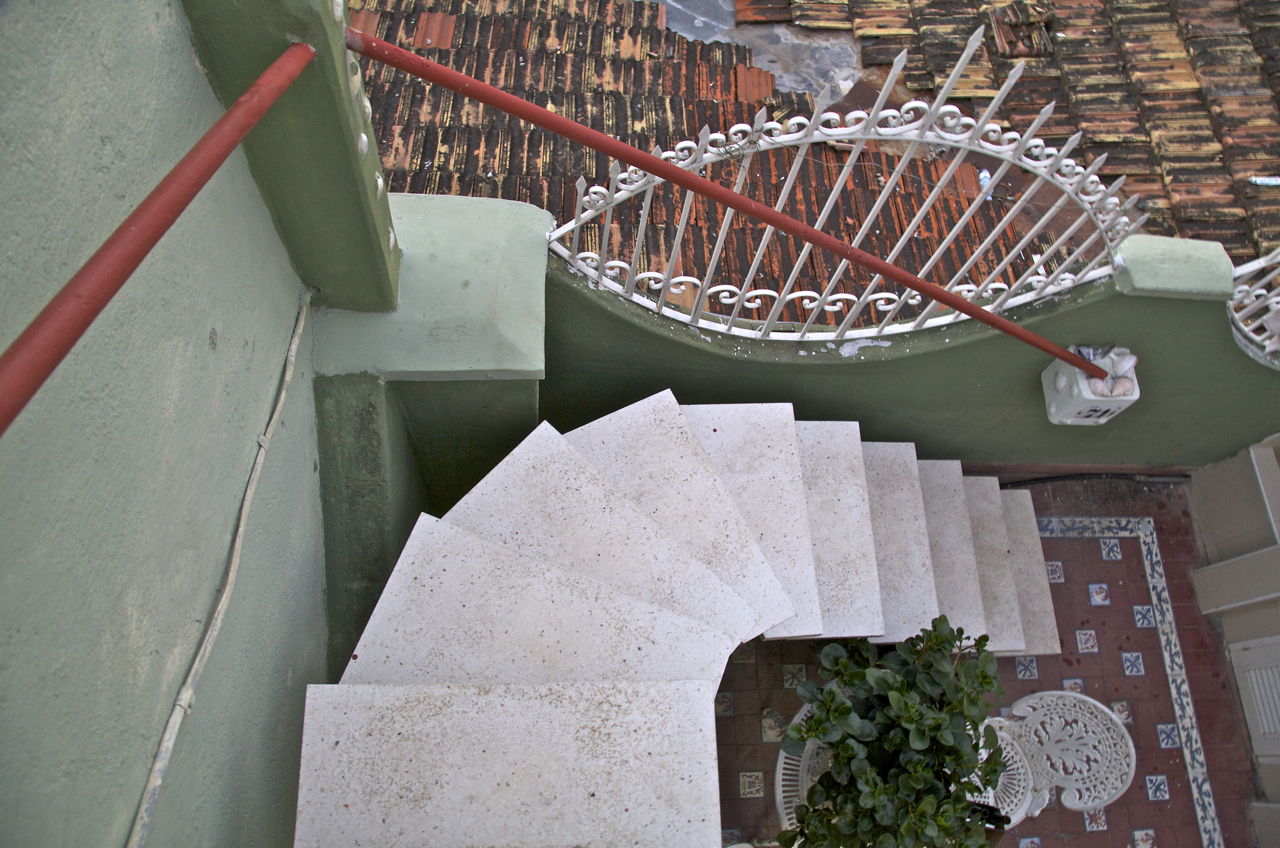
The photo below is looking down the stairway which leads to the roof.


The image to the right was made from the roof access stairway looking through the grating to the dining area.

I included the photo below of the roof top table (the one at which Bob is sitting reading - above) because it tells a bit about our host, Amed. There were 3 bottles of water lying on a piece of heavy black plastic. We puzzled about this for a while before asking Amed about it. He said it was a bit of an experiment. He had read or someone had told him that leaving bottles of water on a black background in the sun would heat the water enough to make it safe for anyone to drink. We didn't go into how he intended to test this, but I was certainly not about to volunteer. But this seems characteristic of Amed who is constantly thinking outside the box, questioning, looking for solutions to problems and exchanging ideas - we had lots of fascinating discussions with him while we were staying at his home.

Sunset from the Casa roof top. Note the sliver of the bay and the dome of the provincial government house.


We did get out briefly to walk a bit in the area near our Casa Particulare, which is only about 5 or 6 blocks from the central square, the Plaza de José Marti, in the downtown area of Cienfuegos. Here Bob (and me and my camera) is walking on the pedestrianized boulevard that extends from the Prado to the to the Plaza de José Marti and it is filled with people everyday but Sunday, when it is, eerily, quite empty. The dome of the government house on the plaza is just visible.
A bit about José Marti, whose image seems to appear everywhere in Cuba. Even at the Plaza de la Revolución there is a huge statue of Jose Marti (none of Fidel Castro - see earlier blog post). According to portrayals of Marti, he was a truly extraordinary man, a pioneering philosopher, modernist writer, poet and revolutionary.  He was a force in debates on issues such as slavery, independence and "freedom". His writings, said to be a unifying influence on Cubans around the world, encompass an enormous range including essays, novels, poetry, political commentary, letters and even a children's book. Through his writings and political activity, he became a symbol for Cuba's bid for independence from Spain in the 19th century. For more about José Marti go to José Marti.


An aside comment - I am reminded by the photo above with Bob walking down the boulevard, that one of the things we noticed, especially in Cienfuegos but in Havana as well, was that many walkways and streets undergo a cleaning - either sweeping or washing - at least once and sometimes twice a day. Not all streets of course - we found some, especially in Havana that were quite dirty and littered with trash.
At the plaza in central Cienfuegos, on the north side of the square, is the beautiful Teatro Tomás Terry.

It was built in 1887 to honour the Cuban industrialist Thomás Terry who, through involvement in all aspects of the economy, from the sugar trade and slave trade to banking and imports, became the dominant businessman in Cienfuegos and, at one point, possibly the wealthiest man in the world. It is said that one of his very profitable ventures was purchasing ill and malnourished slaves, nourishing them back to health and selling them at a substantial profit.
On the west end of the plaza is the Arco de Triunfo, a unique structure dedicated to Cuban independence and, quite possibly, the only "Arc de Triomphe" outside of Paris.
Also at the west end of the square is the Casa de la Cultura Benjamin Duarte, formerly the Palacio de Ferrer 1918. It is a very striking structure (described as "neoclassical") with a domed roof top cupola which, reportedly, offers an excellent view of the city. Unfortunately, like many buildings in Cuba, though it was supposed to be open by now, it remains closed for repairs.

I like this dark, rather gloomy image - maybe because it expresses my disappointment that we were unable to get in to the building and up to the cupola.


On the south side are shops and cafés in the areas under the arches but the dominant structure is the domed Palacio de Gobierno, the home of the provincial government. Visitors are not allowed in but one can sneak a peak of the palatial staircase through the front door. Of course we checked it out but, while it is nice, it is less impressive to me than I had hoped.
On the southeast corner is the Casa del Fundador, the oldest building in Cienfuegos, now a hotel, but originally the residence of the city's founder Louis D'Clouet. I don't have a photo of it but in this image, though you can't really see much, it is on the left with the Palacio de Gobierno facing.


La Catedral de la Purisima Concepción is on the northeast corner of the square. It still serves a religious function though, as it is undergoing major renovations, the area open the public is quite small and in the lower end of the nave where there are rather rough looking benches and a makeshift altar. We visited the Catedral twice and at the second visit we did manage to see the front of the nave, and through all of the scaffolding.

We had heard from our hosts, Amed and Ines, that there is to be a concert at the Teatro Tomás Terry tonight, so we decided to find out about the program, price etc. Unfortunately, I had decided not to take my camera - unfortunately because when we got to the Teatro we found that we were allowed (for 4 CUC's) to go into the Teatro just to see what it was like. It turned out that the orchestra was rehearsing but more interesting than the orchestra practice was the theatre itself - fortunately Bob had his iPhone camera so these photos of the inside of the theatre are Bob's.

Then home for a rest and the ongoing effort to make sure our fluid intake at least keeps pace with fluid loss - not easy to do when we are losing due to both our illness and substantial loss from perspiration in the persistent near 30 ° C temperatures.

As the day progressed it became clear that the wisest choice was for us to forgo the concert tonight, but we would try to go on Saturday instead when, with luck, we would both be healthy. So, Amed and Ines went to the concert without us.

Friday, February 1, 2013

Cuba - Day 7, January 9th


We got up early in order to catch the bus to Cienfuegos. Bob went for breakfast but I did not as I am still not feeling well enough to eat. Even with the benefit of several doses of Imodium, the four hour bus ride to Cienfuegos on the south coast of Cuba felt like a risky business given the continuation of my illness. Fortunately, six Imodiums held the problem at bay and we arrived at our Casa Particulare in Cienfuegos without any embarrassing events.

The bus, according to the Lonely Planet guide, is the most punctual and reliable form of transportation in Cuba so we were very careful to arrive at the hotel pick up location at the recommended 30 minutes prior to scheduled departure.  So, we were very surprised, and annoyed, that it was almost 1 1/2 hours late! Which means we had been waiting for 2 hours during which time my anxiety about the effectiveness of the Imodium over an additional 4 hours of travel, continued to mount. The fellow who came to the waiting area to announce the arrival of the bus greeted us as cheerfully as if things were right on schedule.

Thankfully, the Chinese manufactured bus was quite comfortable with good air-conditioning (not excessive as the Lonely Planet folks warned). It would have been reassuring if it had had a "baño" (a toilet - euphemistically referred to on buses that have one, as the WC) but, unfortunately, this bus did not.

I took photos during the bus ride  some of which turned out surprisingly well considering they were taken from a vehicle moving at about 60 or 70 Km/hour or faster.


Hopefully, these photos will provide some impression of the Cuban countryside in this area.

The landscape is very variable, in places quite flat reminiscent of the Canadian prairies, except for the sugar cane growing there, but mixed with some wetland areas as we moved southerly.


In some areas the soil is distinctly red, likely due to the content of iron, while in others it is rather just brown dirt. One of the things we learned on this trip that was a bit surprising is that a major agricultural crop in Cuba is rice, and we saw several rice fields along the way (photo above)


Some of the farms had a couple of cows (often brahmas but in a couple of fields we saw several Holsteins - a breed which Canada apparently had some role in introducing to Cuba), a horse or two and in some places there were a few goats.

Several homes had quite lovely flowering bushes near the house, like this one above. I'm not sure what these flowers are but I think they could be Bougainvillaea.

As you might appreciate from the photos, the houses appear to be made of concrete, concrete blocks or stone - there appears to be very little wood in house construction in this part of Cuba.


We passed through several small villages, like this one where the homes are very closely situated, possibly even attached.


At the Hotel Union where the bus left us Bob found a Cuban fellow who offered to lead us to our Casa Particulare, Casa Ines Isabel.  We walked about 6 blocks on this extremely hot afternoon, towing our bags over cobblestone streets under the watchful eyes of folks on the street, and, as I was feeling quite weak from fluid loss and limited food intake, I found the walk very tiring.

After arriving at the casa and meeting our host, Amed (about whom, much more later), we learned that things are not to be as planned. Amed's wife's sister is about to have surgery for breast cancer and for that they need to go to Santa Clara which is about 60 Km from Cienfuegos. Since Amed's wife will join her sister and Amed will accompany them, we will not be able to stay here past Sunday, January 12. Amed will find another place for us to stay, but it does mean that we cannot settle in here for the remainder of our stay in Cuba.

More about our Casa and our hosts later, but as you no doubt appreciate from these photos, it is a beautiful place and it turned out to be much more than a bed and breakfast. For example, not only did Amed prepare the meals (tonight, for me, he made a tasty soup and for Bob, who is feeling better, he prepared fresh fish with rice, potatoes and salad, beer and café followed by a dessert. All for a price, of course, albeit quite inexpensive) but he was a wellspring of information about Cuban history, things that we should try to see around Cienfuegos and much more.

I missed most of the latter part of the dinner as I was feeling very tired and unwell so went to our room. And, for me, that was the end of day 7.